


Advances in dental materials, digital design, and clinical techniques have made it far easier to replace missing teeth with results that look natural and feel comfortable. While dental implants and fixed bridgework remain excellent long-term solutions for many patients, removable dentures and partials continue to be a reliable option for restoring a complete, functional smile.
At Lutz Dental, our approach to removable prosthetics blends modern laboratory processes with careful clinical planning to deliver appliances that support facial contour, speech, and eating habits. Every denture we craft is intended to be both practical and attractive, helping patients regain confidence without sacrificing comfort.
We build treatment plans around each person’s needs, focusing on predictable function and ease of care. Whether a patient is replacing a few missing teeth with a partial or restoring an entire arch, our team prioritizes stability, fit, and a natural appearance.
Losing one or more teeth affects more than just the way a smile looks. Gaps change how forces are distributed when you bite and chew, which can lead to additional wear on remaining teeth and make hard-to-chew foods difficult to eat. Over time, this can limit dietary choices and affect overall nutrition.
When teeth are missing, the jawbone that once supported them tends to remodel and shrink, a process known as bone resorption. That gradual change in bone and soft-tissue support alters facial contours and can make the lower face appear shorter or collapsed if left unaddressed.
Speech is another everyday function that can be altered by tooth loss. Teeth guide the tongue and lips during conversation; replacing missing teeth with well-designed dentures helps restore clarity and confidence when speaking in social or professional settings.
Because tooth loss often connects to oral disease, injury, or medical conditions, addressing missing teeth with an appropriate prosthetic is part of maintaining long-term oral health. Early evaluation and a clear plan reduce the chance of further complications and help preserve remaining natural teeth whenever possible.

Removable dentures are appliances that rest on the gums and surrounding oral tissues, using a base that supports lifelike artificial teeth. Their design balances aesthetics with function: tooth size, shape, and position are selected to harmonize with the patient’s facial proportions while restoring chewing efficiency.
One key advantage of a removable solution is maintainability. Because dentures can be taken out, both the appliance and the underlying tissues can be cleaned more thoroughly. This accessibility makes it easier to care for remaining natural teeth and to reduce irritation or infection in the mouth.
Contemporary denture bases and teeth are made from materials that resist staining and wear while offering a comfortable fit. Digital workflows and precise laboratory techniques allow our team to fine-tune occlusion and appearance so the finished prosthesis performs well in daily life.
For many patients, modern removable dentures are not simply a stopgap — they are thoughtfully engineered restorations that can deliver dependable function and an attractive smile when designed and fitted properly.
Determining whether a partial or a full denture is the best option depends on how many natural teeth remain, the condition of those teeth, and the health of the gums and jawbone. A careful clinical exam, along with appropriate imaging, helps our team recommend the most suitable prosthetic approach for long-term success.
Partial dentures are designed to fill one or several gaps in a dental arch while using remaining teeth for support and retention. They are an effective way to stabilize the bite and prevent adjacent teeth from shifting into empty spaces.
Complete or full dentures replace all teeth in the upper arch, the lower arch, or both, and are custom-tailored to the anatomy of the mouth. Where possible, we assess whether any remaining teeth can provide extra support or if extractions and a full-arch solution will yield a better outcome.
For patients seeking greater stability, options include overdentures that anchor to existing tooth roots or to implants. When implants are used to retain a denture, the result often offers markedly improved retention and confidence for chewing and speaking.
Complete-arch dentures are intended for cases where most or all teeth on an arch are missing or no longer restorable. The design focuses on tissue fit, esthetic tooth display, and balanced bite relationships to ensure comfort and predictable function.
Immediate dentures are inserted at the time teeth are removed so the patient never has to go without teeth during healing. While this offers immediate cosmetic benefit, subsequent adjustments or relines are common as soft tissues and bone remodel during recovery.
Overdentures
Overdentures are full or partial prostheses that gain extra support from either preserved tooth roots or attachments on implants. This improves retention and can slow the rate of bone loss in the areas where support is maintained.
Implant-retained dentures
Implant-retained dentures clip or snap onto small dental implants placed in the jaw. This hybrid approach combines the simplicity of a removable appliance with the improved stability of implant support, making eating and speaking easier for many patients.
When healthy teeth remain, partial dentures provide a conservative route to rehabilitation. They are often anchored with clasps or precision attachments designed to minimize stress on supporting teeth and to blend discreetly with the natural dentition.
Contemporary partial frameworks can be made from cast metal, flexible resins, or hybrid materials, and tooth components are selected to match color and shape for a seamless appearance. A well-designed partial helps preserve tooth position and restores the balance of the bite.
Our team evaluates each case individually to recommend a partial design that best aligns with the patient’s oral condition, functional needs, and esthetic expectations.
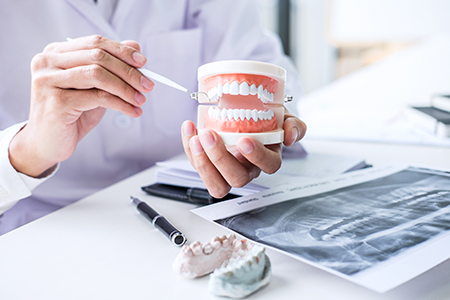
Successful dentures begin with a thorough assessment: medical and dental history, a complete oral exam, and imaging as needed. These steps allow the care team to identify any pre-prosthetic needs such as extractions, soft-tissue management, or periodontal therapy that will improve the final fit and comfort.
Impressions, bite records, and try-in appointments are opportunities to fine-tune tooth position, occlusion, and aesthetics. These clinical stages are where digital planning and skilled laboratory work come together so the finished appliance fits harmoniously in the mouth.
Material selection and laboratory technique matter. We work with experienced dental technicians and time-tested materials to create dentures that resist wear, look natural, and maintain a strong relationship with the surrounding tissues.
Coordination among the dentist, the laboratory, and the patient—paired with methodical adjustments after delivery—helps transform a carefully planned restoration into a reliable, everyday solution.

Receiving a new denture is a process. In the first days and weeks, patients commonly experience increased saliva flow and slight changes in speech and chewing patterns. These reactions are normal and typically resolve as the mouth adapts.
Fitting and minor adjustments
It’s not unusual to need one or more adjustment visits after delivery. Small sore spots are corrected quickly during follow-up appointments to improve comfort and relieve pressure areas.
Regaining speaking confidence
Practicing speaking aloud and reading can accelerate adaptation. With time, most patients find their pronunciation returns to normal as they become accustomed to the feel of the appliance.
Eating with a denture
Begin with soft, manageable foods and bite evenly with both sides. As confidence grows, a broader range of foods can be reintroduced. Implant-retained options often allow a faster return to more varied chewing.
Ongoing cleaning and tissue care
Rinse and brush the denture daily and soak it overnight in water or a recommended cleanser to keep it free of debris and staining.
Clean and brush any remaining natural teeth and gently care for the gums and palate to maintain healthy supporting tissues.
Remove dentures at night to allow tissues to rest and to reduce the risk of irritation or infection.
When added retention may be helpful
Some patients benefit from adhesives for minor retention needs, while others choose implant attachments or precision attachments for markedly improved stability. We review these options during treatment planning.
Regular checkups and relines
Routine visits allow us to evaluate fit, make adjustments, and check the health of the oral tissues. Over time, a reline or remount may be necessary to restore optimal fit as underlying tissues remodel.
Our practice is committed to helping patients transition smoothly to a comfortable, attractive denture that supports daily life. If you would like to learn more about the denture and partial options we offer, please contact us for additional information and to discuss the solution that best meets your needs.
Today, it’s easier than ever to replace missing teeth and achieve natural-looking, durable, and long-lasting results! Depending on a patient’s dental needs, lifestyle, expectations of care, and budget, choices can include conventional fixed bridgework, dental implants, or removable partial and complete dentures. At the office of Lutz Dental, we’ll discuss all your options in care and answer all your questions as you choose the solution that’s right for you.
With advances in dental materials and technology, today’s dentures are more comfortable and realistic-looking than ever before.
Whether you wear partial or complete dentures, it’s essential to see the dentist for routine care. Besides checking the fit and condition of your dentures and making any necessary adjustments, you’ll also receive a comprehensive exam to check on the health of any remaining teeth as well as the soft and hard tissues in and around the oral cavity.
A same-day denture offers an accelerated design and fabrication process that allows a patient to go from impression taking to denture insertion in a single day.
For patients who don’t want to wait after having teeth extracted, an immediate denture can be inserted the same day your teeth are removed. Sometime later you may need the denture relined to address any changes in its fit once the extraction sites have completely healed.
While no one wants to drop or break a partial or complete denture, accidents do happen. The good news is that in some cases, your partial or complete denture is reparable. It all depends on the extent of the damage. Don’t hesitate to contact our office if you’ve broken or damaged your denture. We’re happy to help.
The simple act of taking your partial denture in and out can cause certain types of metal clasps to loosen over time. When you come in for your checkup visit or contact our office for an adjustment, we’ll assess the fit of your partial and tighten the clasps for improved stability and comfort.
While rebuilding a complete smile is a worthwhile investment, our office is sensitive to the costs involved in dental care. We customize care and will discuss which treatment options address your needs, lifestyle, and budget. How much a new denture will cost depends on the type of the prosthesis, its design, and the materials used to fabricate the supportive base, teeth, and clasps or precision attachments. Dentures that include the placement of dental implants for added retention and stability typically involve additional costs.
If you have dental insurance, your coverage may include a new or replacement set of dentures. Our staff is happy to review your coverage with you to ensure you are maximizing your insurance benefits while minimizing any out of pocket expenses.
At the office of Lutz Dental, we provide an extensive range of dental services, including the latest and most effective methods to help patients with missing teeth rebuild complete and beautiful smiles. As skilled and experienced professionals, we recognize that every patient is different, and every smile is unique. We’re passionate about what we do and take great pride in providing personalized treatment plans while treating our patients as valued partners in care.
Dentures are removable dental prostheses that replace a full arch or multiple missing teeth, while partials replace one or several missing teeth and attach to remaining natural teeth. Both options restore chewing function, support facial structure, and help improve appearance and speech. Modern dentures and partials are designed to be comfortable and natural-looking using advanced impression and fabrication techniques.
Full dentures sit on the gums and rely on suction, tissue fit, or adhesives for stability, whereas partials typically use clasps or precision attachments to anchor to adjacent teeth. Materials range from acrylic resin to stronger base materials and lifelike tooth composites for improved durability and esthetics. Your dentist will recommend the most appropriate design based on how many teeth are missing, the health of remaining teeth, and your oral anatomy.
A good candidate for dentures or partials is someone with missing teeth who seeks to restore function and appearance and who has healthy enough oral tissues to support a prosthesis. During an evaluation, the dentist will assess gum health, bone volume, the condition of remaining teeth, and overall oral hygiene to determine suitability. Medical history and habits such as smoking or certain medications are also reviewed because they can affect healing and fit.
If remaining teeth are compromised but salvageable, the dentist may recommend restorations or crowns to support a partial. In cases of advanced tooth loss or inadequate bone for tooth-supported options, implant-supported prostheses may be discussed as an alternative to conventional dentures. A comprehensive exam, often including digital imaging, helps create a treatment plan tailored to each patient’s needs.
The process typically begins with a consultation and oral examination, followed by impressions and measurements to create custom prostheses. Multiple appointments are common, including try-ins to verify fit and appearance, adjustments to occlusion, and a final delivery appointment where the denture or partial is fitted and explained. If extractions or tissue changes are needed, the timeline may be extended to allow healing before final fabrication.
Temporary or immediate dentures may be provided when teeth are extracted so patients are not without teeth during healing, but these often require subsequent relines or replacements as tissue contours change. Patients receive instructions on insertion, removal, cleaning, and adaptation to speaking and eating. The practice will schedule follow-up visits to fine-tune fit and address any soreness or pressure points.
Adapting to dentures or partials varies by individual but most patients need several weeks to become comfortable with eating and speaking. Initially, increased saliva flow, minor irritation, and changes in speech are common as the mouth learns to accommodate the new prosthesis. Practicing reading aloud, starting with soft foods, and gradually introducing firmer textures can speed up adaptation and build confidence.
Follow-up appointments are important because adjustments for sore spots or bite alignment significantly improve comfort and function. Over time, the muscles of the lips, cheeks, and tongue learn to hold the prosthesis in place more effectively. If persistent problems occur, the dentist can evaluate fit, occlusion, and whether a reline or different design would be beneficial.
Daily cleaning is essential to prevent plaque buildup, staining, and odor; prostheses should be rinsed after meals and cleaned with a soft brush and nonabrasive cleanser outside the mouth. Overnight soaking in a recommended denture-soaking solution or plain water helps keep acrylic components hydrated and maintains fit. It is also important to brush any remaining natural teeth, gums, tongue, and palate to preserve oral health and prevent gum disease.
Regular dental visits allow the dentist to check fit, oral tissues, and the condition of the prosthesis; over time, relines or repairs may be necessary as the shape of the mouth changes. Avoid using hot water, abrasive pastes, or household cleaners that can damage denture materials. Storing dentures safely when not in use protects them from warping or accidental breakage.
Conventional dentures rest on the gums and rely on tissue support and, in some cases, adhesives for retention, while implant-supported dentures attach to dental implants placed in the jaw. Implant-supported options provide markedly improved stability, reduce slippage, and allow greater chewing efficiency compared with traditional denture bases. They also help preserve jawbone by transmitting functional forces to the bone, slowing resorption that commonly follows tooth loss.
Not every patient is a candidate for implants, and the decision depends on bone volume, general health, and surgical considerations. Implant-supported prostheses require surgical placement of implants and a healing period before final attachments are placed, but they often deliver superior function and long-term satisfaction. Your dentist can review whether a fixed or removable implant-retained solution best meets your needs and lifestyle.
Well-designed partial dentures are made to distribute forces evenly and minimize stress on the abutment teeth that support them. Poorly fitting or excessively rigid clasps can place undue pressure on supporting teeth and increase the risk of wear or loosening over time, which is why precise design and fit are essential. Routine monitoring and adjustments help protect natural teeth and maintain a healthy occlusion.
When necessary, the dentist may recommend modifying or restoring abutment teeth with crowns or precision attachments to improve support and longevity. Good oral hygiene, regular dental exams, and prompt attention to any mobility or discomfort help preserve both the prosthesis and the remaining natural dentition. Thoughtful planning at the outset reduces the likelihood of adverse effects on supporting teeth.
Because the underlying bone and gum tissues change slowly over time, most denture wearers will require periodic relines or adjustments to maintain comfort and fit. Early follow-up visits are usually scheduled within days to weeks after delivery to address immediate pressure points, with additional checkups every six to twelve months or as recommended. Factors such as weight changes, ongoing extractions, or natural bone resorption influence how frequently adjustments are needed.
Promptly reporting sore spots, looseness, or difficulty chewing allows the dentist to make timely corrections and prevent more significant problems. Relines can often be performed in the office to adapt the denture base to current tissue contours, while more extensive issues may require remaking the prosthesis. Regular professional care helps extend the lifespan and performance of dentures and partials.
Dentures and partials are commonly constructed from acrylic resin, nylon-based flexible materials, or metal-acrylic combinations, with teeth made from acrylic or porcelain. Acrylic bases are widely used for their ease of adjustment and natural appearance, while flexible partials offer comfort and lighter weight but may be less retentive in some situations. Metal frameworks provide strength and precision for partials that rely on clasps and rests for support.
The choice of material depends on clinical needs, esthetic goals, and functional demands; the dentist evaluates bite forces, esthetic expectations, and the health of adjacent teeth before recommending a material. Each option has trade-offs for durability, repairability, and cost of maintenance, so discussing long-term care and preferences with your dentist helps determine the best path. Selecting a well-planned design with appropriate materials leads to more predictable outcomes.
New dentures or partials can temporarily alter speech and chewing mechanics, especially for sounds that rely on tongue placement against teeth, and patients may notice changes in bite force and food textures. Practicing speaking slowly, reading aloud, and beginning with soft, easy-to-chew foods helps retrain muscles and improve clarity. Cutting food into small pieces and chewing on both sides can enhance stability and comfort during meals.
As you adapt, gradually introduce firmer foods to build confidence and chewing strength, and maintain follow-up visits for adjustments if chewing or speech issues persist. If persistent difficulty with certain sounds or foods continues, the dentist may evaluate fit, occlusion, or the need for minor modifications. With patience and guidance, most patients regain comfortable speech and efficient eating within a few weeks to months.
You should contact your dentist promptly if you experience persistent pain, sore spots that do not resolve after adjustment, sudden loosening, cracking or visible damage to the prosthesis, or changes in your bite or chewing ability. Ongoing irritation can lead to ulceration or infection, and delayed evaluation may complicate treatment. Any sign of broken clasps, worn teeth, or instability that affects daily function merits professional attention.
For routine concerns and scheduled maintenance, your dentist at Lutz Dental can assess fit, perform relines, make repairs, and recommend alternatives if needs change. Timely care preserves oral health and helps the prosthesis function as intended, so do not hesitate to book an appointment when issues arise. Regular checkups also allow early detection of related conditions such as gum disease or changes in jaw health.
Quick Links
Contact Us
